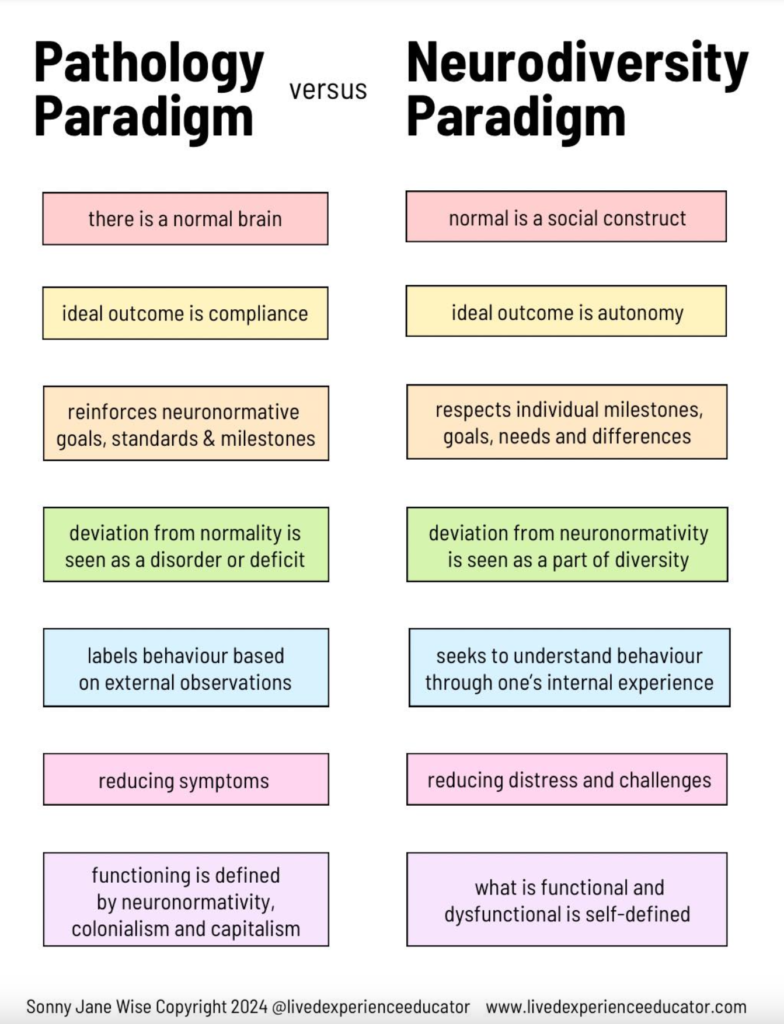
While the traditional/medical model of disabilities frames disability as a “deficit” and aims to cure disabilities through treatment, the Social Model of Disability frames a disability as a “difference” and aims to use treatment to accept the disability and modify the environment to accommodate it.
My goal is somewhere in between these two models: I strive to give children the skills they need so they can choose how they communicate.
The vast majority of the families I work with (100% right now) use insurance to pay for their treatment – this means that my reports and notes have to include test results that establish a communication deficit, communication goals, and progress towards those goals in order for insurance to pay for my services. But even when I have a private-pay family I still use the principles of the medical model because I like to be sure the families are getting what they’re paying for: increased skills for their children.
But as I work with these children I want to make sure I’m affirming their neurodiversity. Here are some principles I follow to do so…
My Principles of Neurodiversity-Affirming Care
- Respecting & encouraging autonomy
- I don’t like forcing children to do anything, though I am not against enticing them to do so.
- I keep a variety of prizes the children can earn as rewards for their hard work and even incorporated a token-based system so they can save up points from each session and get more expensive rewards (like Beyblades). Since none of us work for free it’s actually functional to teach kids to earn rewards for their hard work.
- I use very limited hand-over-hand cueing. I confess I’ve never felt comfortable with this kind of cueing unless kids actually request it from me by placing their hand into mine (which has only happened once). When those in the Autism community voiced concern over this cueing and went so far as labeling it “inhumane” I embraced my discomfort and vowed to limit it to only 2 months for each new word. I try to move on to less invasive cueing (like pointing or hand-under-hand cueing) as fast as possible.
- I never work on limiting stimming behaviors, though I’ll help children understand others’ points of view about various stimming behaviors and if a child wants to modify their stimming I will help them problem-solve to figure out ways to do so. The same goes for behaviors that make us all look like we’re not paying attention like reduced eye gaze, which I’m very guilty of, myself, due to my sleep disorder.
- Collaborating with families (and older children) on goals and treatment techniques
- I always get parent permission before using hand-over-hand cueing while explaining the concern those within the Autism community have voiced about it.
- If a child is adverse to any of the techniques I use I find alternative methods of achieving their goal.
- Once a child reaches adolescence I start seeking their input on our goals.
- Prioritizing children’s safety and comfort
- I only raise my voice or get into kids’ bubbles is when safety is compromised, though I occasionally get close to a child when trying to help them achieve the correct position of their lips, tongues, or mouths to achieve a speech sound.
- I try to keep my treatment room organized and quiet in order to reduce sensory and cognitive overload and help kids focus on their work. For some kids this includes putting away toys that are too distracting or moving furniture that a child climbs on.
- Providing robust communication tools (like AAC iPad apps)
- I use the Picture Exchange Communication System (PECS) with the goal of it being a “stepping stone” to more robust communication methods like spoken words, sign language, or AAC apps on an iPad. I use The Total Communication Method so that kids can choose which robust communication modality fits them best.
- Teaching self-advocacy
- Across the developmental lifespan, I encourage individuals to express their needs and boundaries even when they’re things like “I don’t like coming to Speech.” I find ways to help children learn resiliency skills since doing things we don’t necessarily want to (like eating vegetables for me) is a key life skill while also honoring their preferences when I can.
- Respecting boundaries
- I try to keep prizes that are motivating for all the kids I work with, especially for kids who aren’t as intrinsically motivated to complete their speech & language work. When a kid chooses “no work & no prize” over “work & prize” I try to entice them to stay for their appointment for a few minutes. If this choice continues then it is honored and they’re sent home early (even though that will mean a reduction in my revenue starting in 2027). When this happens it’s not uncommon for a parent to text me later to say their child came down with a fever shortly after our appointment.
- I was trained to use the “person first” model of disability language, which means I say, “a person with Autism” by default, but when a parent/child uses “identity first” langauge by saying, “an Autistic” or “An Autistic person” I try to adapt. It’s difficult to remember which families use which language model, though.
The Telepathy Tapes
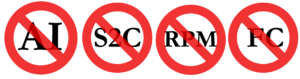
In truth, this post and my post about Total Communication were inspired by the current popularization of “The Telepathy Tapes,” the “Spell 2 Communicate (S2C)” program, and the “Rapid Prompting Method (RPM)” program. Here are my objections to these…
- S2C & RPM are identical to Facilitated Communication (FC), which was debunked in the 1990s after dozens of its users made allegations of abuse, some against the very caregivers who helped them to facilitate their communication. Testing repeatedly demonstrated that these users’ messages were from the facilitator, rather than the user. If we accept telepathy as an explanation of these test results then we’re robbing these users of safety by disregarding their allegations.
- The long-term hand-over-hand cueing required for the S2C and RPM programs directly contradicts the advocacy of those with Autism against hand-over-hand cueing. The focus on compliance over communication in these programs has been proven repeatedly to decrease communication attempts.
- S2C & RPM invalidate the reality of those living with cognitive impairments. These programs claim that those with severe Autism Spectrum Disorder who are nonverbal/pre-symbolic are experiencing a fine motor deficit, rather than a cognitive impairment; by invalidating the experiences of those with cognitive impairments we rob them of the treatment and/or modifications that could alleviate their struggles due to their cognitive impairments.
- Accepting the idea that those who are nonverbal/pre-symbolic with severe Autism and a cognitive impairment are experiencing a “fine motor deficit,” rather than a neurological deficit, robs these individuals of their current pre-symbolic communication. Caregivers are encouraged by FC/S2C/RPM to disregard the subtle cues and methods of pre-symbolic communication used by these individuals if they believe those movements are unintentional due to a motor impairment, rather than an intentional & unique modality of communication.
- Studies have repeatedly demonstrated that while the facial expressions of those with Autism Spectrum Disorder may be more subtle, they still accurately depict the person’s mood (as measured by blood cortisol levels and heart beat analysis).
- The intensity of training for users of S2C & RPM eliminates any time they could use to try or explore other communication modalities like I do with Total Communication. In addition, studies have shown that children who were subjected to FC demonstrated decreased pre-symbolic communication such as pushing items away when they were unwanted – this is likely due to the program’s focus on compliance.
I want to help families looking for S2C, RPM, or similar techniques understand that I do not provide these techniques and the techniques I use are vastly different mainly because they prioritize autonomy over compliance.
The SLP A to Z Blog
FREE Regulation Tools Menu

FAQ: “What is ‘Total Communication’?”
FAQ: “What is ‘Neurodiversity-Affirming Care’?”
Toca Boca World Guides
Barrier Game: Toca Boca World (physical edition)
New FREE Handouts from Social Thinking
Barrier Game: SpongeBob Magnetic Tins

FREE Handout: The ABCs of Summer Boredom

Regulation Tool: Lava Lamps

Regulation Tools: Feelings Ninja & Feelings Thermometer

FREE 5-Finger Retell Slide