I was first introduced to “Total Communication” while volunteering at a preschool for the Deaf while I was win college. Using this method, the SLP, OT, and teachers used spoken English, American Sign Language (ASL) signs, and Alternative/Augmentative Communication (AAC) devices to communicate with the children in the school. I loved how this meant the kids could use whichever communication modality fit the best for them in the moment and with their learning style.
I now use Total Communication with all my patients who are learning to use language through spoken/signed/AAC words. I like to call these kids “pre-symbolic” since there is so much communication that develops before words. Since so man people are unfamiliar with that term I usually use “pre-verbal,” rather than “non-verbal” (because I never want to presume a child won’t go on to use words later).
One of the biggest reasons I use Total Communication is because it’s neurodiversity-affirming care; it gives kids the ability to choose which communication modality fits best for them. The down-side is that it’s quite a high cognitive load to be using 3 communication modalities at a time so I tend to narrow the modalities as a child uses only 1 or 2 (I keep using all 3 for the kids who use all 3).
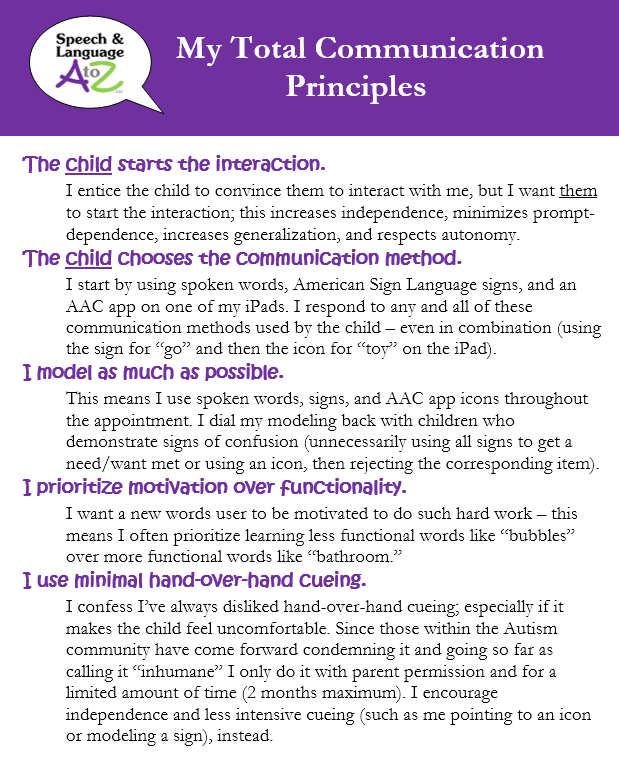
Here are some principles I use with my pre-verbal patients as I’m providing Total Communication…
Tips for AAC
I’ve also been trying to think of tips for parents who are using AAC devices. Here’s what I have so far…
- Let your child lead. If your child uses a word you didn’t expect, roll with it instead of correcting them. An exception is when a child requests something and then refuse it when you give it to them – then help them find the word that goes with the item they want and, ideally, have them activate the icon (you can help them by pointing to it).
- Keep the AAC readily available. Keep it charged and with (ideally strapped to) the child at all times. If it’s an iPad app keep the iPad on, charged, and unlocked (with “guided access” on so that the child can’t switch to other apps).
- Let the kids play with their words! As hard as it can be to hear the same word 1,000 times in a day, this is a natural part of the language acquisition process.
- MODEL, MODEL, MODEL! Use the AAC as the child would as often as possible. If the child becomes possessive of their device you can set up the same app on a second iPad or even your phone. An exception should be made if the child demonstrates signs of confusion (using a word then rejecting the item that goes with that word).
- Try to comment more and ask fewer questions. This encourages children to start interactions, rather than just responding to others.
- Honor all modalities of communication. If a child says a word there’s no need to make them use their device to repeat it.
PECS
I confess I’ve never felt comfortable with hand-over-hand cueing unless kids actually request it from me by placing their hand into mine (which has only happened once with the dozens of pre-symbolic kids I’ve worked with). Once those in the Autism community voiced concern over this cueing and went so far as labeling it “inhumane” I embraced my discomfort.
Other clinicians have abandoned the use of the Picture Exchange Communication System (PECS) since it’s heavily dependent on hand-over-hand cueing in the initial stages and it’s a limited (rather than robust) communication system. While I completely respect my colleagues’ decision in this area, I’ve had too many kids who used PECS as a stepping stone to more robust systems for me to completely disavow it. Instead, I always educate parents about the concerns over hand-over-hand cueing expressed by the Autism community before I start PECS with a family. I also limit my use of hand-over-hand cueing to only 2 months for each level. I move on to less invasive cueing (like pointing or hand-under-hand cueing) as fast as possible.
The Telepathy Tapes
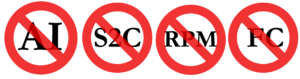
In truth, this post and my post about Neurodiversity-Affirming Care were inspired by the current popularization of “The Telepathy Tapes,” the “Spell 2 Communicate (S2C)” program, and the “Rapid Prompting Method (RPM)” program. Here are my objections to these…
- S2C & RPM are identical to Facilitated Communication (FC), which was debunked in the 1990s after dozens of its users made allegations of abuse, some against the very caregivers who helped them to facilitate their communication. Testing repeatedly demonstrated that these users’ messages were from the facilitator, rather than the user. If we accept telepathy as an explanation of these test results then we’re robbing these users of safety by disregarding their allegations.
- The long-term hand-over-hand cueing required for the S2C and RPM programs directly contradicts the advocacy of those with Autism against hand-over-hand cueing.
- S2C & RPM invalidate the reality of those living with cognitive impairments. These programs claim that those with severe Autism Spectrum Disorder who are nonverbal/pre-symbolic are experiencing a fine motor deficit, rather than a cognitive impairment; if we invalidate the experiences of those with cognitive impairments we then rob them of the treatment and/or modifications that could alleviate their struggles due to their cognitive impairments.
- Accepting the idea that those who are nonverbal/pre-symbolic with severe Autism and a cognitive impairment are experiencing a “fine motor deficit,” rather than a neurological deficit robs these individuals of their current communication. Caregivers are likely to disregard the subtle cues and methods of pre-symbolic communication used by these individuals if they believe those movements are unintentional due to a motor impairment, rather than an intentional & unique modality of communication.
- The intensity of training for users of S2C & RPM eliminates any time they could use to try or explore other communication modalities like I do with Total Communication.
I want to help families looking for S2C, RPM, or similar techniques understand that I do not provide these techniques and the techniques I use are vastly different mainly because they prioritize autonomy over compliance.
The SLP A to Z Blog
FREE Regulation Tools Menu

FAQ: “What is ‘Total Communication’?”
FAQ: “What is ‘Neurodiversity-Affirming Care’?”
Toca Boca World Guides
Barrier Game: Toca Boca World (physical edition)
New FREE Handouts from Social Thinking
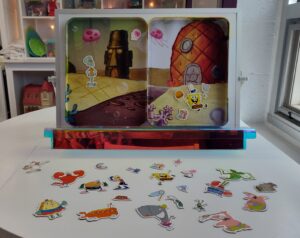
Barrier Game: SpongeBob Magnetic Tins

FREE Handout: The ABCs of Summer Boredom

Regulation Tool: Lava Lamps

Regulation Tools: Feelings Ninja & Feelings Thermometer

FREE 5-Finger Retell Slide